
UDC Busted Mugshots: What the Locator Covers
UDC stands for the Utah Department of Corrections. Its public offender locator tracks state supervision. It is not a statewide arrest list or a county jail roster. Booking happens after an arrest. At that point an agency logs identity and custody details. Plenty of people get booked by a county and never enter UDC supervision. Others appear in UDC records later. A court hands down a sentence that includes prison, parole, or probation.
That difference explains many blank results. The locator covers people under UDC supervision right now. Folks awaiting trial in a county jail sit outside it, by the agency's own description. A county roster, where one exists, answers the local custody question instead. Treat a UDC result as a lead on state status. It is not proof of a county booking or a case outcome.
State and county custody can overlap, too. Through its Inmate Placement Program, UDC houses some sentenced people in county jails. A county facility named in a UDC record reflects housing under that program. It does not create a new county arrest. Keep the agency and the legal stage attached to every result you compare.
The UDC offender search states its own limits up front. Its notice says the tool covers people under UDC supervision. It excludes those awaiting trial or not yet sentenced in county jail. Read that notice first. Never treat a missing name as meaningful without it. County custody records answer the booking question; UDC adds the state supervision layer on top.
Search UDC Offender Records by Name
Go straight to UDC's own search form. Skip copied commercial indexes. The form takes a name or a UDC offender number. For names, enter at least one letter of both first and last. Extra name details help narrow common names. The UDC number, when you have it, pins down a state corrections record; it is not a county booking number or a court case number.
Compare identity and status fields before trusting any match. A shared name alone cannot tie a profile to an arrest. If nothing comes up, the person may be in county pretrial custody, off supervision entirely, or serving a federal sentence. Those are separate systems. Reach the tool through the UDC offender search page.
- Open the official UDC offender-search page and read the scope notice.
- Enter at least one letter in the first-name and last-name fields, or use the UDC offender number.
- Add other known name details when the form offers them and the name is common.
- Open a result and check the identity, supervision status, and listed location together.
- For a charge or court outcome, follow the court case information rather than inferring it from the UDC status.
This official search interface is where a state supervision question starts. The agency's notice and search area appear on the page, not a gallery of faces.
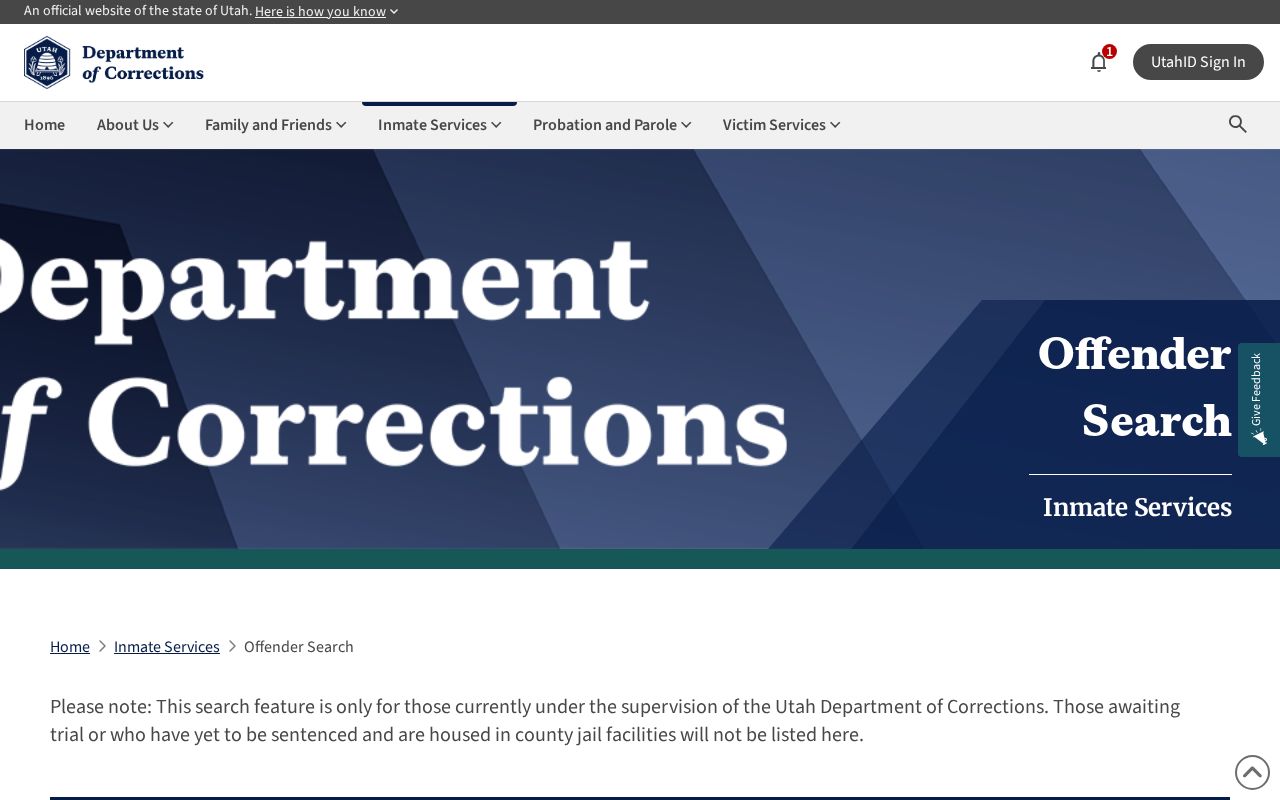
Check a result's status and location on the day you view it. The locator's scope can shift. So can the fields it displays. Return to the official page for current instructions.
Note: A UDC offender number is a state identifier; use county booking or court case numbers only with the agency that issued them.
What a UDC Profile Can Show
UDC's media and public-information materials list several types of offender information. That information may appear in a public record. What shows up in a search result depends on the record. The person's status matters too. The category "Prison Photo/Mug Shot" appears in that material. That does not guarantee the live locator displays an image for each person. Read each field as one piece of a state record. It is never a full history.
The table below mirrors the categories UDC identifies as includable information. Some cover current supervision or placement. Others point back to a sentence or a board action. None of them is promised in every profile.
| Profile field or category | What it can tell you |
|---|---|
| Date of birth | An identity detail to compare with other official records. Do not rely on a name match alone. |
| UDC offender number | The identifier for the person's UDC record. It is different from a county booking or court case number. |
| Legal status | Whether the person is listed as an inmate, parolee, or probationer, when that status is part of the public information. |
| Housing location | The facility or county placement associated with state supervision, when disclosed. |
| Offenses and sentence length | Sentence-related details held by UDC. Court records remain the source for case filings and outcomes. |
| Board hearing and parole details | A hearing date, parole information, or an expiration detail when included in the record. |
| Sentencing court, date, and case number | Case identifiers that can help locate the related court record. |
| “Prison Photo/Mug Shot” | A category named by UDC's public-information materials. It does not promise that a photo is visible in the online result. |
Use the UDC number and court identifiers to keep records straight. A booking number belongs to the local booking agency. A court case number points to a court file. A sentence field may summarize a court action, but the docket and disposition hold the direct record of what happened.
- Supervision
- State oversight that can include prison custody, parole, or probation.
- Disposition
- The court's outcome in a case, such as a dismissal, plea, or judgment.
- GRAMA
- Utah's Government Records Access and Management Act, the state law used to request existing government records.
- Parole
- Release from prison while remaining under state supervision and its conditions.
- Probation
- Court-ordered supervision in the community.
When Can UDC Mugshots Appear?
UDC treats offender photos as a records category. Its public-information page names “Prison Photo/Mug Shot” outright. The live offender locator works differently, built to confirm identity and custody status. It does not promise a picture with every match. So the category only tells you the image exists. It does not mean the shot is public, or that it came from a county booking.
Photos do not follow a fixed clock. UDC posts no universal schedule for when offender photos are taken, replaced, or refreshed. No single retention period covers every profile. If the date matters to you, ask for the version and date of the existing record in a narrow request.
The UDC Media and Public Information page is the agency's home for these categories. It also spells out how to ask about a specific record. Check it before you write, since instructions can change.
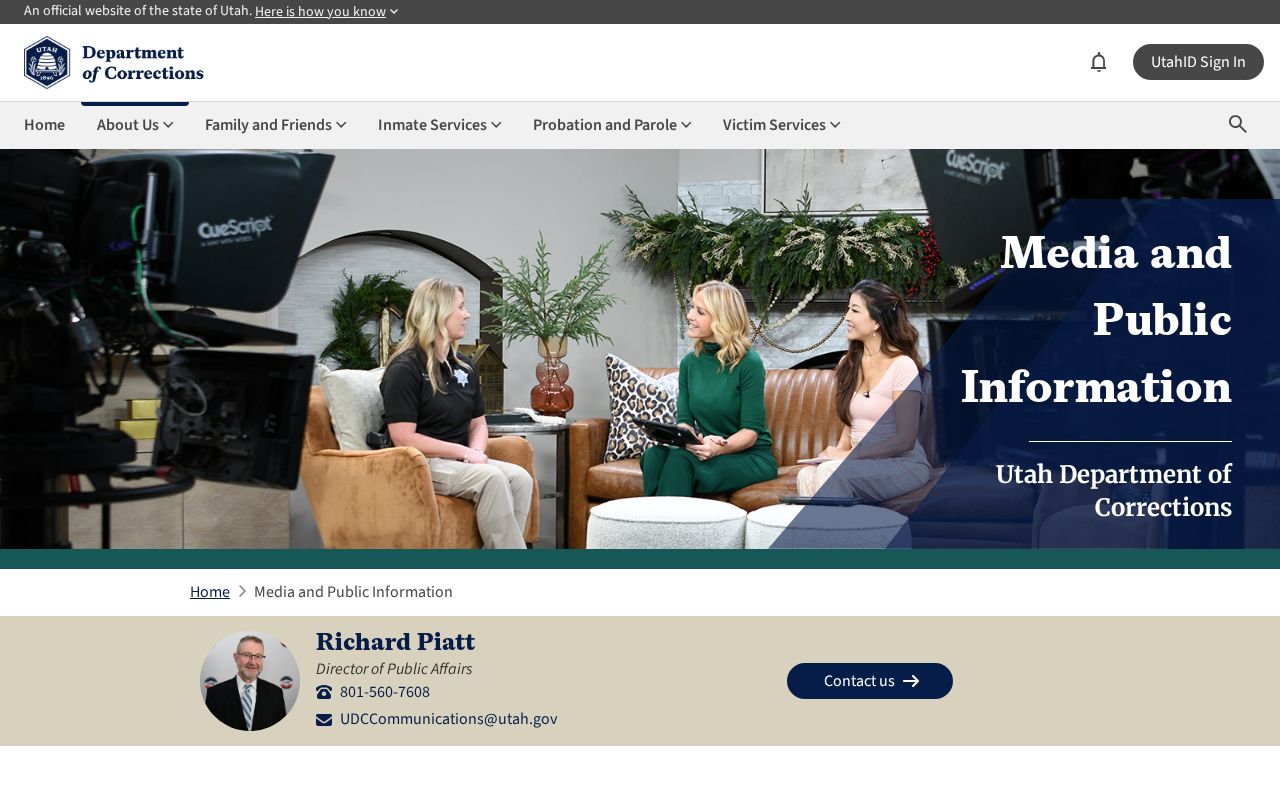
UDC's public-information section is what this image shows. It is not an offender-photo display. Photos appear there only as a named records category, while online visibility and update timing carry no guarantee.
Note: A “Prison Photo/Mug Shot” category does not confirm a photo's date, its source event, or how the person looks today.
Busted in Utah: Who Appears in UDC?
A UDC profile tracks current state supervision. A county booking entry records a local arrest. The two can overlap. UDC will sometimes house a sentenced person in a county jail. Even so, they answer different questions. They may also sit with different agencies. Someone booked and released before any state sentence may never show up in UDC. A person on parole or probation can appear there without sitting in a county jail at all.
County booking photos carry their own Utah legal rules. A jail booking image is not a supervision photo. State law puts jail booking images in a protected-record framework with specified exceptions. A county's roster fields or photo releases cannot be inferred from what UDC shows. Ask the county custodian for the booking record and its photo status. The Utah County Directory leads to those local sources.
| Question | UDC offender record | County booking record |
|---|---|---|
| Why does the record exist? | To identify a person under state corrections supervision. | To document arrest processing or local custody. |
| Who maintains it? | Utah Department of Corrections. | The county sheriff, jail, or arresting agency that holds the record. |
| Who may appear? | People currently under UDC supervision, including some people on parole or probation. | People booked or held by that county agency, subject to its system and current record window. |
| Does it promise a photo? | No. UDC identifies prison photo/mug shot as a records category but does not promise a visible image for each profile. | No. County access and publication are governed by the county record and state booking-image rules. |
| Best next source | UDC's official offender locator or a specific UDC GRAMA request. | The relevant county roster, jail, or records unit. |
Keep the stages straight. Arrest and booking can happen before a prosecutor files; sentencing comes later through the courts. Parole and probation are state supervision, not custody events. Never relabel a photo from one system as coming from another. For a county arrest question, use the county path. Do this even if UDC lists a matching name.
Note: A county placement shows where a state-sentenced person is held, not where the arrest happened.
Request UDC Photos through GRAMA
Need a specific existing photo? UDC's answer is a written GRAMA request. The current Department records route begins at the agency's contact page. Follow the live records-request instructions there. Ask for one identifiable record. Give the person's name and the UDC offender number if known. Include the record type plus a date or date range to help the custodian locate it. Say you want an existing record, such as a specific “Prison Photo/Mug Shot.” Do not ask for a new report or a bulk set of every image.
GRAMA never requires a new compilation. UDC reviews each request under the law. Its safety, security, and privacy rules apply to every request, and an image can be withheld or redacted even when other profile fields are released. A request is not a promise. The image may not exist or may not be public. Since no fee or deadline is posted, rely on the live request instructions for current terms instead of guessed numbers.
- Open the current UDC contact and records page and select its GRAMA route.
- Identify the person, including a UDC offender number when available, and describe the specific existing record.
- Add a useful date range or record date, and ask for the image date or version if that detail matters.
- Review UDC's response for any access decision, redaction, fee notice, or review path.
The official UDC contact page confirms the current request method. Its general contact section is what the image displays, so use the active records links there. A static image is never a request form.
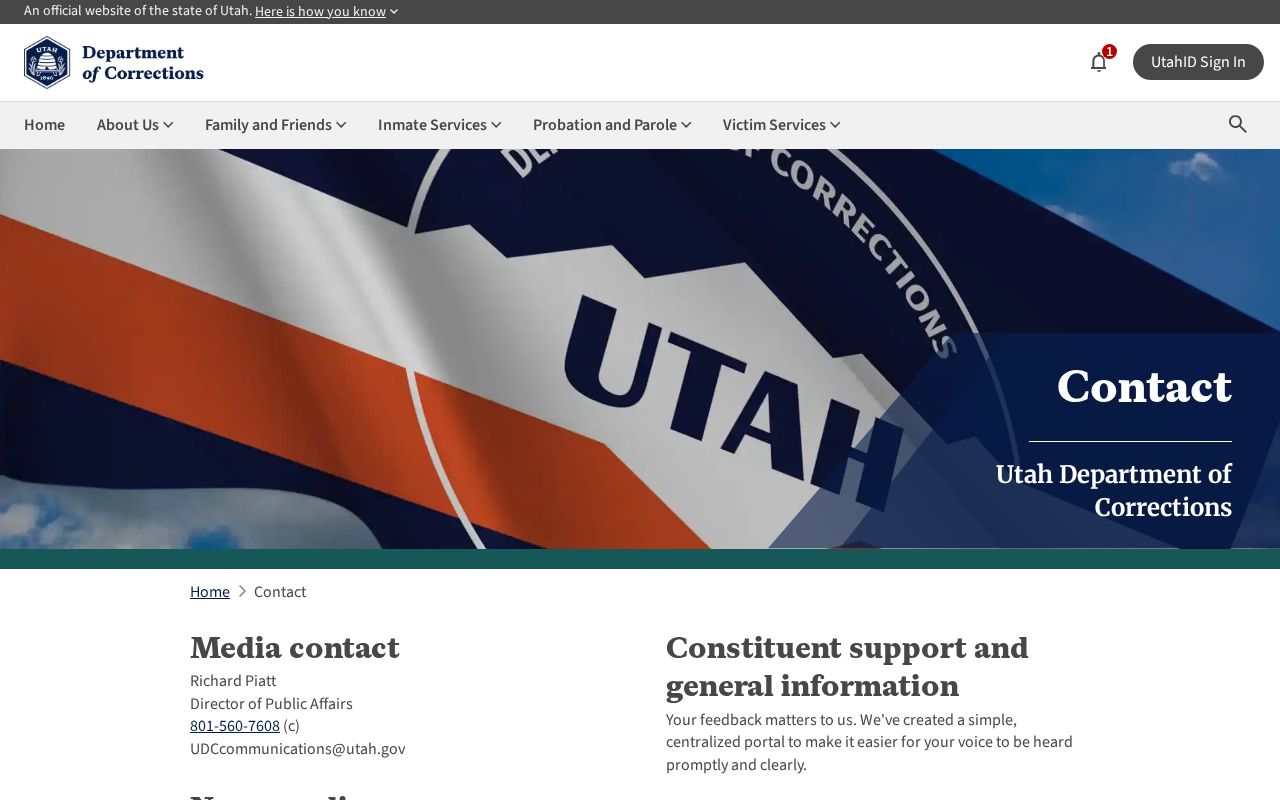
UDC's media and public-information material also tells requesters to seek an existing record in writing. Its safety, security, and privacy limits stand. A narrow request works better than a bulk demand.
Do Busted People Stay in UDC Search?
The UDC locator tracks current supervision. It is not a lifetime archive. Parole and probation records can keep a person visible, with a status tied to that supervision. Discharge changes things. Once UDC supervision ends, the system promises no continued public listing, and older arrest history may drop from view. Nobody should read the locator as a complete record of prior arrests. Think of it as a live status board.
A missing profile can mean several things. Maybe the person sits outside UDC's scope now. Maybe the name was entered differently, or the event lives only in a county jail or court file. The result says nothing about county arrests. It will not tell you whether a prosecutor filed a charge or whether a court cleared a case, so check the court record when the outcome matters and confirm with the agency holding the person when custody status does. One missing name is not proof of anything.
UDC also runs a victim notification service. That tool is separate. Registered users receive custody-event notices, covering release, transfer, escape, return from escape, death, or parole release. It holds no offender photos. It does not replace the public locator or an agency's direct confirmation either. Each service answers a different question. A profile search shows supervision details; a notification service sends updates.
Note: A former offender may vanish from the search when UDC supervision ends, while county and court records follow their own access and retention rules.
Busted in Utah: UDC or BOP?
A Utah prison record is not always a UDC record. Some people in federal custody fall outside the state system entirely. The Federal Bureau of Prisons keeps its own inmate locator for those cases. That search takes a name or a BOP register number. The register number is a federal identifier. It is not a UDC offender number. It is not a county booking number either.
The BOP Inmate Locator covers federal inmates incarcerated from 1982 to the present. Results can include location and release information. It will not act as a county-arrest lookup, and it publishes no booking photos. A silhouette or profile graphic in the interface is just a placeholder. Treat that shape as design, not as a mugshot. Also remember the limits. A result here is not a full criminal history. The absence of one is not a record of every Utah arrest.
This official federal locator displays the separate BOP name and register-number search. It appears here only to mark the routing split. It does not turn the federal service into a source of UDC photos.
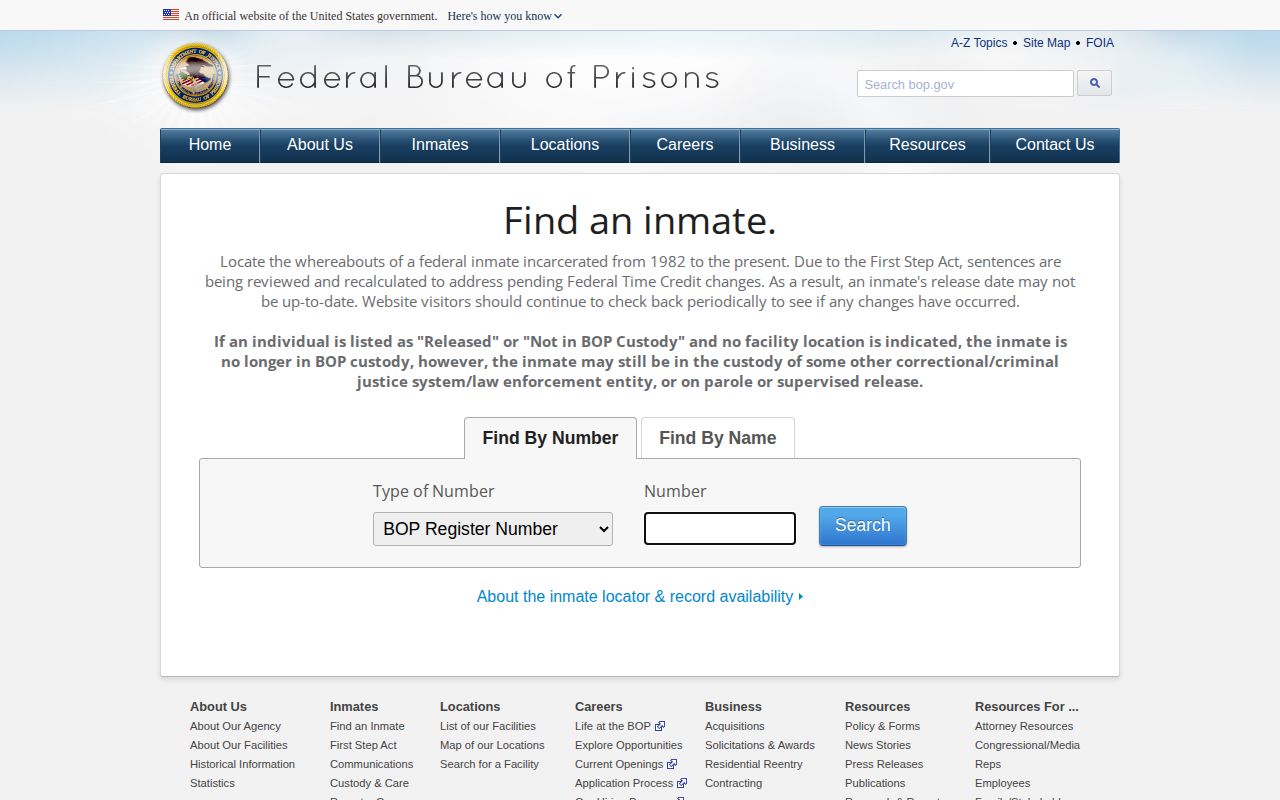
Federal records follow a different path. BOP maintains a separate FOIA process for requests, and federal disclosure rules and exemptions govern what comes back. No public photo result is promised. Keep that route distinct from UDC's Utah GRAMA process.
Across all these systems, the sequence stays simple. First, identify which agency held the person. Then read the status as of the search date. Finally, confirm any charge or outcome in the court record.